Here is the precedent I talked about in class... it is outside of Chicago but has interesting re-use of industrial/manufacturing materials:
http://www.studiogang.net/work/2003/fordcalumetenvironmentalcenter
In an interesting twist, it is apparently too expensive of a design to be built in the current economic climate...
Sunday, February 10, 2013

Composite Material Websites
http://www.compositesworld.com/articles/the-building-envelope-betting-on-the-big-time
http://composites.owenscorning.com/processes/Sheet_Molding_Compound.aspx
http://www.acelltec.com/en/case-study
http://composites.owenscorning.com/processes/Sheet_Molding_Compound.aspx
http://www.acelltec.com/en/case-study
Tuesday, February 5, 2013
Sustainable Urban Farm - Shipping Containers
Prefab home competition entry - creation of a sustainable urban farm with the use of shipping containers.


Interesting Multi-family precedent
Winning competition entry for student housing complex in Denmark:


Connection between interior and exterior space.

Use of directionality in design to interact with surroundings.
Interior Flexibility Characteristics
All information and images listed below came from analysis found in the following journal article:
Jovanovic, Goran and Milica Zikovic. A Method for Evaluating the Degree of Housing Unit Flexibility in Multi-family Housing. FACTA UNIVERSITATIS Series: Architecture and Civil Engineering Vol. 10, No 1, 2012, pp. 17 - 32.
Flexibility in multi-family housing can be understood in three ways:
1) Amount which spatial organization is dictated by static/permanent elements
2) Potential for multifunctional use of the space
3) Ability for changes in number and size of rooms
These three factors dictate how much flexibility a family will have in conforming their own space to their needs, specifically to changing needs over time. The article on flexibility in housing, by Zikovic and Jovanovic, gives specific criteria for evaluating "in-unit" flexibility of various layouts and conditions. This criteria can then be applied to examples of multi-family prefab housing in the US to create a level of comparison based on unit flexibility as a subset of "mutate-able" prefab housing.
Factors which impact degree of flexibility in multi-family units:
ORIENTATION: Number of exterior walls in unit - the greater number of exterior walls provides greater flexibility as it provides more locations for residential rooms which would desire light and ventilation.

One sided orientation creates a zone of auxiliary rooms along the "back" wall of the apartment. Variable layouts suggest that overall flexibility is limited as light/ventilation is desirable for all residential rooms.

Two sided orientation - creates more flexibility as residential rooms can be spaced out across the width of the unit. Auxiliary (MEP system) rooms are shaded, designating their location along one of the non-exposed walls.
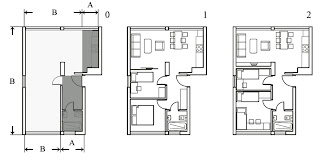
Three sided orientation - allows for position of all rooms to achieve desired level of outdoor access. Rooms can be placed based on solar orientation - day/night use. Auxiliary rooms are located along one non-exterior wall.
GEOMETRY OF PLAN: A more centralized plans allows for greater flexibility in rooms size and location. A geometry with a number of exterior jogs creates spaces that are more restricted in their layouts.

Centralized geometry allows for open multifunctional space to be laid out in multiple directions.

A more jagged perimeter provides arguably less flexibility, however it does appear that there could be more flexibility in above plan than is indicated. However for a desire to accomodate three bedrooms, this layout is not very flexible.
CHANGING SIZE OF FAMILY: The requirements of a family of 2, 3 and 4 vary in the number of rooms and amount of space. A floorplan would need to be sized for a family of 4 in order to be able to easily be reconfigured for a family of 4. Potential for add-ons to the unit can be considered as part of the unit mutation.

Proposed unit layout changes to accomodate a family of 2, 3 or 4. There is not quite enough space in the apartment shown to be adapted for a family of 4.
LOCATION OF ENTRANCE: A centrally located entrance allows for more flexibility as it removes requirement for longer corridors to access all areas of the apartment.

Central entrance more easily creates access to all spaces.

Peripheral entrance requires more circulation space to reach all rooms. This limits flexibility from the standpoint of not being able to divide the space by the entrance into private rooms.
LOCATION OF MEP SYSTEMS: MEP cores that have enough room surrounding them for multiple room types and layouts provide the greatest overall flexibility. A central MEP core in a large size apartment ma be able to accomodate this, or a demising wall MEP core in a smaller unit. The more MEP core locations within the unit, the less flexible the layout becomes in moving around them.

MEP core located at demising walls.

Centrally located MEP core.

Multiple MEP cores throughout unit interior - limit flexibility.

Structural elements highlights to show ease in changing one interior wall location.
In summary, it appears there are some useful criteria for understanding how easy the Built In Mutation can be for the interior of the prefab units. Allowing users to reconfigure their interior spaces gives them control over how they use their apartment. It would be interesting to understand how much flexibility is built into current prefab systems and also how prefab could be designed for allowing reconfiguration of interior walls.
Sunday, February 3, 2013
Flexibility in Multifamily Housing - Research Summary
Summary of research in:
Investing the Concept of Courtyard for Sustainable Adaptable Multifamily Housing
Ali H. Al Jameel and Omar A. Al Hafith
Department of Architectural Engineering Faculty of Engineering, Mosul University, IRAQ
Benefits of multifamily housing (as pertaining to Detroit) are consolidated energy/MEP services.
Dwellings are not able to incorporate the changes required between the different stages of life of its occupants.
Adaptability as the "extent to which the building can be adapted" to meet the changes its residents require. Allows the ability to remain in the same residence, and mutate it throughout - making it uniquely ones own.
Design Properties as related to adaptable housing:
1) Structure concentration and modularity - concentrating the supporting elements of the structure allows greater flexibility to change smaller elements without requiring modification to the structure. have a repeatable modular structural system allows for easier integration of new building components and structure which can more easily be incorporated into the existing structural matrix.
2) Zoning of "special provisions"- zoning the areas of the dwelling based on A) activity requirements in that area of the dwelling and B) properties of the building. Ex - zoning of kitchens and bathrooms based on services required and and activities carried out in them.
3) Independency of Building Elements - the ability to change out particular elements of the dwelling independently, matching with user requirements of material life cycle without having to impact other building elements that do not need the be modified.

Example of flexibility in unit demising
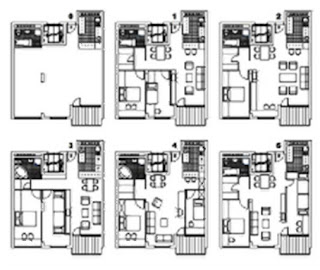
Examples of flexibility of layout within one unit

"Special provision" areas shown in blue (bathroom, kitchen) note that these have been zoned into a specific part of the unit, and are not reconfigured with the rest of the unit.
Concept of Mathematical analysis:
Structure Modularity: # of types of compound structural units / # of compound structural units
(less is argued to be more adaptable)
Structure Concentration: Two indicators
# of supporting units / area of building
Area of supporting units / area of building
This research points to a hierarchy of structure and housing zones that allow for independency between zones and units. This, in combination with prefab design could result in interchangeable pieces of buildings that could fit within an overall structure and core system, creating the ability to change the layout and elements of a building easily, based on needs. A challenge comes with developing a system which can be added on to by a variety of companies... the ability to be able to change your space only is useful if 1) the user can change the space or 2) if there is a company that is easily accessible that can do it.
Adaptability in Commercial Pre-fab
I have been doing an investigation of current prefab housing companies to see how they compare in regards to adaptability. Most companies I have looked at have several housing models to choose from, and you are able to customize these models in a minor way. Some have two floor plan options to choose from, and most have customizable finishes. However, the overall design does not appear to be very adaptable.


Link to Kieran Timberlake model home configuration. The website lets you select custom options and live updates the price of the home - much like the concept of the dell computer as they described in Prefabricating Architecture. Much like dell, the base model that is selected cannot be changed, the house is the house and you can decide what finish you want, and which appliances.
In regards to adaptability, selecting a house layout out of a number of predesigned models does not seem to me to give the user enough of an input into the design of their house. Or at least would not give me (granted from the perspective of a designer) as much appeal. When I look at houses or apartments, I am more intrigued by the character of a house, or the cultural context of its location. In taking away the concept of site, it makes me wonder what is important. For me it would be in the ability for the house to reflect some of who I am, through how I would intend to renovate it, or how I would create the layout. The ability to interact with my house is important in the sense that I could have a large impact on how I use it. Just having the ability to change the finishes does not do this for me - finishes don't change how I act within my house, they change the appearance of it.
Two clear paths for creating this interaction seem apparent at first glance. One is being able to alter the house on my own after I purchase it to make it uniquely suited to me, and the second is having (enough) control of the layout during the design process to create my impact to house I will use the house.
I have found some precedents that allow for more customization in the design process (albeit sacrificing some of the economics through this process). The two strongest are Homb Prefab and FlatPak. Both of these companies have created modular building pieces that can be combined to create custom layouts.
Homb relies on a triangular prism as a module, which is connected and stacked to other triangular prisms to develop a unique layout suited to site and user needs. The triangles are assembled into travel modules in the factory and then shipped to the site.
Onsite Construction of 3,900 sqft home in Portland, OR
Interior of Portland, OR home
Rendering of 2,100 sqft home in New Orleans, LA
Modular Plan of New Orleans home
Proposal for multifamily Homb housing
Graphic plan of multi-family housing showing triangular modules
FlatPak is organized based on the concept of a one story, 8' wall section. These sections are customizable with a range of surface materials (glass, opaque panels, etc) and start to dictate how each part of the house is used and how the user wants it to connect to the site.
FlatPak house - exterior envelope flexibility
FlatPak house framing - prior to exterior 8' module installation.
FlatPak house - user selection of exterior skin material.
FlatPak house - construction example
FlatPak house - interior
FlatPak house on stilts
Subscribe to:
Comments (Atom)